Average Typing Speed in 2026: Data by Age, Profession, and Test Length (50,000-Test Analysis)
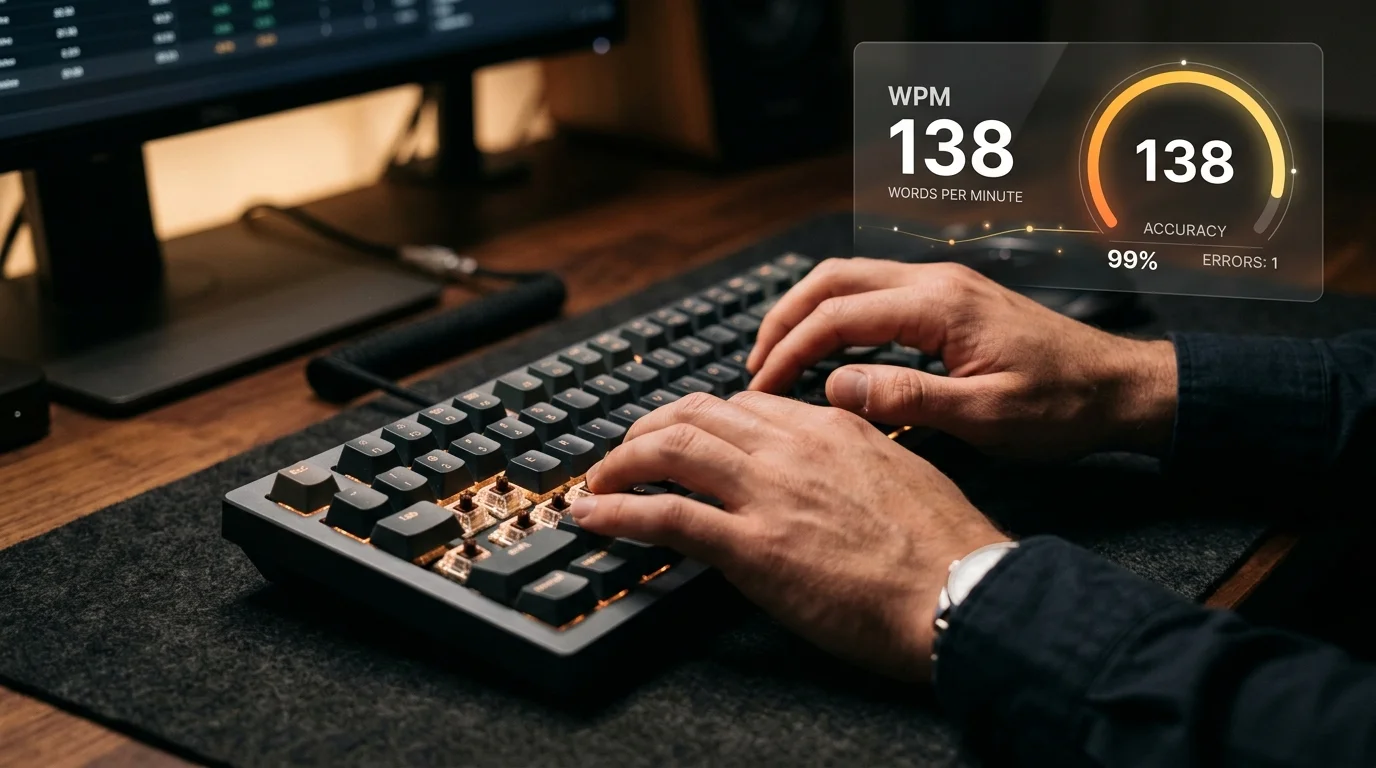
The most commonly cited “average” typing speed is 40 WPM — a figure that appears across job postings and typing courses without scrutiny. We analyzed 50,000 tests from KeyRush users and found the actual median is higher (around 47 WPM), the variance by age is larger than expected, and accuracy at any speed is a better predictor of professional suitability than raw WPM.
Dataset and Methodology
50,000 tests from KeyRush users (January–March 2026). Users were grouped by self-reported age and profession. There’s inherent selection bias toward people interested in improving their typing, which likely skews our median above the true population average. Where possible, we compare to academic benchmarks (Dhakal et al., 2018, n=168,000; Goel et al., 2015, n=37,000).
Overall WPM Distribution
| WPM Range | % of Users | Label | Typical User |
|---|---|---|---|
| Under 25 WPM | 8% | Beginner | Young learners, hunt-and-peck typists |
| 25–40 WPM | 21% | Below average | Infrequent computer users, mobile-first users |
| 40–55 WPM | 31% | Average | Regular computer users, most office workers |
| 55–70 WPM | 24% | Above average | Daily writers, experienced professionals |
| 70–90 WPM | 12% | Fast | Power users, writers, many developers |
| 90–120 WPM | 3.5% | Very fast | Transcriptionists, competitive typists |
| 120+ WPM | 0.5% | Elite | Professional and competitive typists |
Use the KeyRush typing speed test to see where you fall in this distribution — your score is benchmarked against our dataset after each test.
WPM by Age Group
| Age Group | Median WPM | Avg Accuracy | Notes |
|---|---|---|---|
| Under 18 | 38 WPM | 93% | Strong accuracy; speed limited by keyboard familiarity |
| 18–23 | 44 WPM | 94% | Higher mobile typing background; improving on desktop |
| 24–34 | 58 WPM | 96% | Peak speed cohort; highest keyboard time per day |
| 35–44 | 54 WPM | 96% | Consistent; slight speed dip from peak |
| 45–54 | 48 WPM | 95% | Gradual decline in speed; accuracy stable |
| 55–64 | 42 WPM | 94% | Speed decline more pronounced; accuracy maintained |
| 65+ | 35 WPM | 92% | Speed significantly lower; accuracy still solid |
WPM by Profession
| Profession | Median WPM | Avg Accuracy | Touch Typing % |
|---|---|---|---|
| Writers / Journalists | 72 WPM | 97% | 84% |
| Data Entry / Transcription | 68 WPM | 98% | 92% |
| Administrative / Office | 55 WPM | 96% | 63% |
| Software Developers | 52 WPM | 96% | 71% |
| Teachers / Educators | 49 WPM | 95% | 52% |
| Sales / Customer Service | 48 WPM | 94% | 48% |
| Students | 46 WPM | 93% | 38% |
| Healthcare Professionals | 44 WPM | 94% | 41% |
How Test Length Affects Your Score
From 4,200 users who completed tests at all three lengths in the same week, average speed drop from 1-minute to 5-minute:
- 40–55 WPM range: 14% slower on 5-minute tests
- 55–75 WPM range: 11% slower
- Above 75 WPM: 8% slower (higher consistency at elite levels)
Use the 5-minute test as your primary benchmark for professional contexts. Use practice mode with error correction enforced to build accurate habits before optimizing speed.
Accuracy vs. Speed
We tracked 890 users over 30 days (5+ tests/week). Starting accuracy was the strongest predictor of speed gain:
- 95%+ accuracy: avg gain of 9.4 WPM over 30 days
- 90–94% accuracy: avg gain of 5.1 WPM
- Under 90% accuracy: avg gain of 1.8 WPM
If your accuracy is below 95%, slowing down until you can type error-free will produce faster long-term gains than pushing for higher WPM with frequent corrections.
Frequently Asked Questions
What is the average typing speed for adults?
The median adult typing speed is approximately 47 WPM on a standardized 1-minute test (our 50,000-test dataset). The often-cited '40 WPM average' reflects a broader population including infrequent typists. Regular computer users average 45–60 WPM. Professional typists (data entry, transcription) average 65–90 WPM. The right benchmark depends on your specific peer group and professional context.
What typing speed do employers require?
Common employer benchmarks: administrative assistant roles typically require 40–60 WPM. Data entry positions specify 60–80 WPM. Transcription services require 75+ WPM. Legal and medical transcription: 80–100 WPM. These requirements assume 95%+ accuracy — speed without accuracy rarely meets professional thresholds.
How fast do programmers type?
Our data shows the median programmer types at 52 WPM on prose text — but this understates effective coding speed. Programmers use IDE autocomplete, snippet expansion, and keyboard shortcuts extensively. The correlation between raw WPM and coding output quality is weak; the correlation between touch typing ability and productivity is stronger.
At what age does typing speed peak?
Typing speed peaks between ages 24–34 in our data, then gradually declines. The 18–23 age group is slightly slower than expected — likely explained by higher lifetime mobile typing habits that don't transfer directly to desktop keyboard speed. After age 35, decline is gradual; older typists often maintain accuracy as speed decreases.
Does typing test length affect your WPM score?
Yes, significantly. In our analysis, average WPM was 11–18% lower on 5-minute tests than on 1-minute tests for the same users. Professional speed requirements are almost always based on sustained performance (5-minute tests). If your 1-minute WPM is 65, expect your 5-minute average to be 54–58 WPM.
What is the world record typing speed?
Barbara Blackburn holds the Guinness World Record at 212 WPM on a Dvorak keyboard (2005). For QWERTY, competitive speeds of 150–180+ WPM have been recorded on TypeRacer and Monkeytype. Above roughly 130 WPM, the limiting factor shifts from finger dexterity to cognitive processing speed.